
What is the value of a University Press and what challenges do University Presses meet?

This was the focal topic at the symposium, The academic book stands firm: Why a leading university needs its own Press in turbulent times.
The symposium was held on 29 April in Lux Aula, hosted by Lund University and Lund University Press.
Representatives came from Manchester University Press, Oxford University Press and Palgrave Macmillian, along with Swedish academic publishers, i.e., Malmö, Uppsala and Stockholm.
Isak Hammar, a docent in history and publication coordinator at the Joint Faculty of Humanities and Theology at Lund University, was the general moderator and part of the organization team.
What is the value of a University Press?
There are many benefits and values for a university to have a University Press, which were discussed throughout the symposium. Simon Ross’, Chief Executive at Manchester University Press, mentioned many of these benefits in his talk, such as:
- UPs are channels of their University’s mission, promote the brand globally, and have international reach and impact.
- UPs build a reputation and reliable publishing infrastructure/services that benefit their Universities.
Simon Ross also listed some interesting facts: the UK is the largest exporter of books in the world, and Oxford University Press is the biggest University Press in the world. Print books are still dominant (approx. 80 percent) in the UK. However, half of the revenue at Manchester University Press comes from Print and half from Digital.
The Scholarly Book and Why It Matters
Josie Dixon, Consultant in Scholarly Publishing and Research Communication, pointed out that “publish and perish” has led to a crisis in journal publishing. The volumes of journals have increased, with papermills and AI-generated articles, whereas a book is long-lived and could be so for decades and said:
“The process of constructing and writing a book is often a core way to shape the ideas, structure the argument… At their best, monographs provoke debate, can shift paradigms, and provide a focal point for research.”
The Editor’s role is essential in this process. Meredith Carroll, Senior Commissioning Editor from Manchester University Press, talked on Academic Book Publishing From an Editor’s Point of View.
A summarized statement, also of the symposium, regarding the role of the editor was that:
“Everyone needs an Editor”
The multifaceted publishing landscape
Isak Hammar’s presentation focused on Open Access, peer review and local infrastructures.
He pointed out that the publishing landscape is multifaceted, pluralistic, culturally and academically. This is a challenge for all universities in Sweden, which was recently discussed at a Networking event on academic publishing organized by Malmö University.
As an example of a stakeholder in Sweden, he mentioned Kriterium, which offers a platform for review, publication and dissemination of high-quality academic books. (https://www.kriterium.se/site/en-welcome/)
Stockholm University Press Managing Editors Sofie Wennström and Petter Blomqvist focused their presentation on how the press provides an open and affordable alternative route for publishing that aligns with the university’s goals and open science policy. Publications are based on scientific value rather than market value, and all publishing decisions are made by researchers.
Panel discussion: The University Press and academic book publishing in general
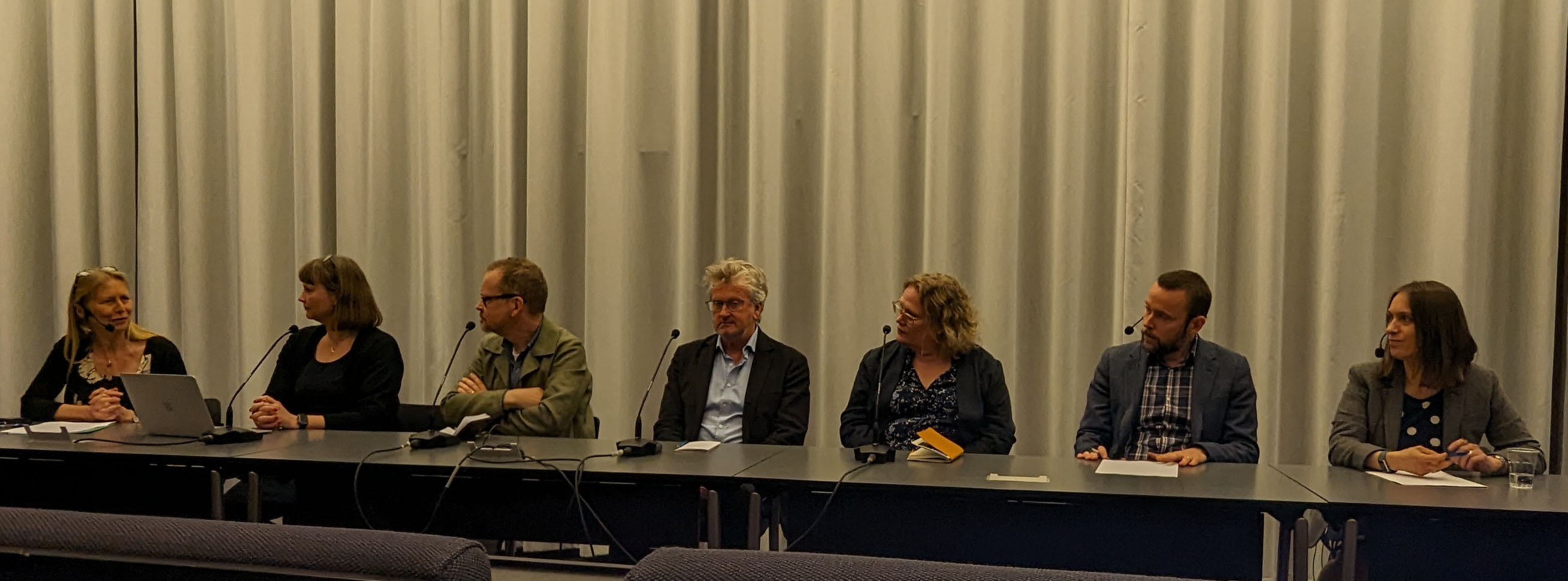
Participants: Representatives from Lund University Press, Manchester University Press and Stockholm University Press. Moderator: Josie Dixon. Here are some of the things that were discussed:
- Every UP needs a policy to accept a publication based on quality, not fees.
- We must look at equal opportunities (equity) in publishing regarding funding and supporting smaller publishers.
- One of the reasons to have a University Press is to publish open access, have an alternative infrastructure for publishing, however we don’t always fit into the ecosystem of prestige.
- The university ecosystem is challenging since it does not promote book publishing. It’s more profitable for researchers to write articles.
- Where do you learn how to write as a researcher?
- People are interested in and curious about Sweden. They want to read and learn more about Sweden’s ‘strangeness’.
- How do we deal with research projects versus actual ”book ideas”?
Marianne Thormählen, Lund University Press Publishing Director, stated in her closing words of the Symposium that:
“We need well written, high quality and trustworthy academic books and that University Presses have a value for their universities.” (Marianne Thormählen, Lund University Press Publishing Director)
Join the discussion on why University Presses matters
The Stockholm University Press team agrees that University Presses have value for their universities and that we need high-quality and trustworthy books – and we aim to contribute to this.
Please let us know your thoughts on this blog post. You are always welcome to contact us publish@su.se
 Stockholm University Press Blog