
By interweaving philological analysis, archaeological evidence and mythological narratives, Indo-European Afterlives offers new perspectives on how notions of death and the beyond were embedded in early Indo-European belief systems.
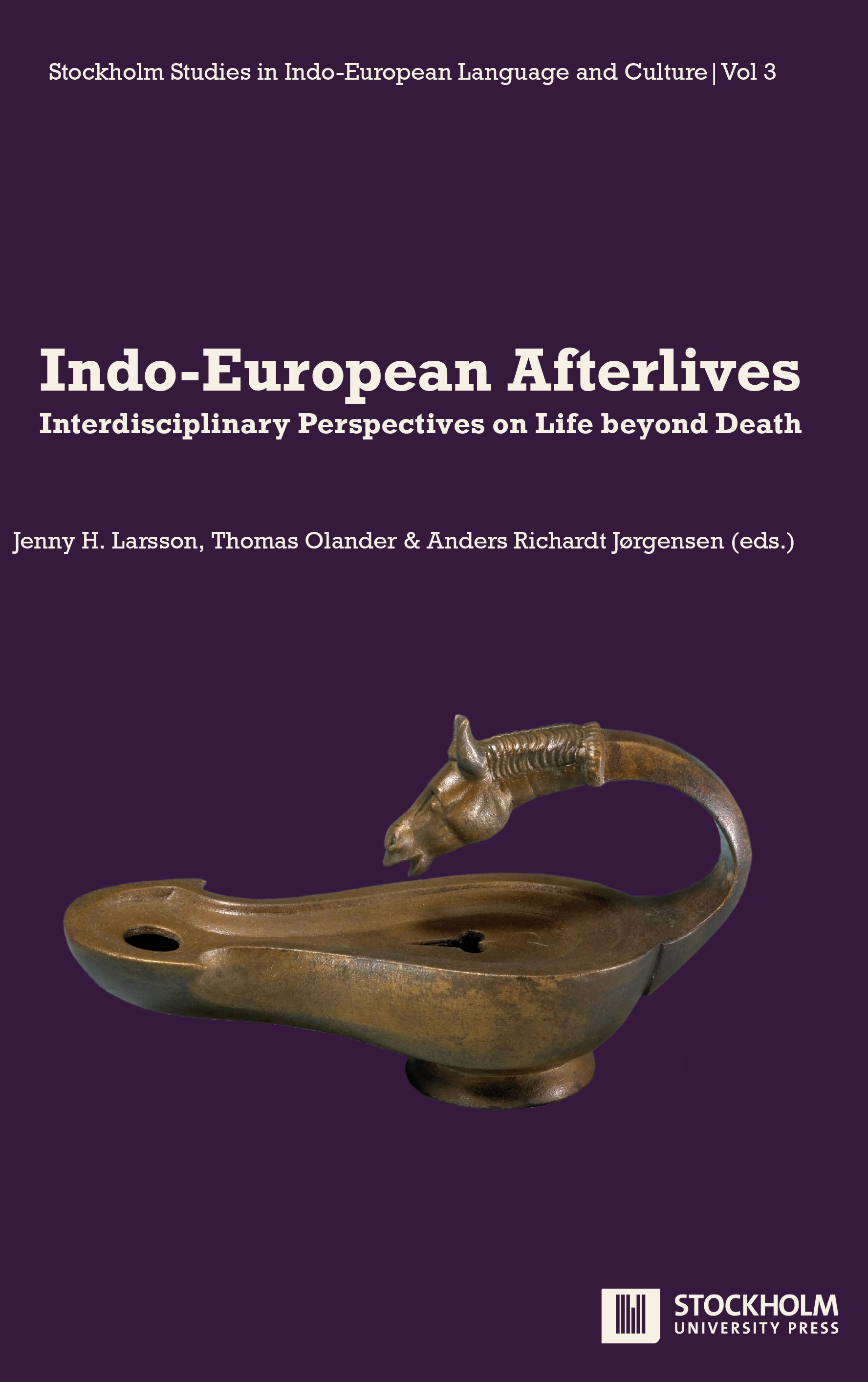
From poetic visions of the afterlife to the ritual logic of cremation and the etymology of mourning, Indo-European Afterlives examines how the transition from life to death was conceptualized and ritualized across the Indo-European world. Topics include the eschatological power of poetry, the symbolic role of fire in funerary rites, linguistic reconstructions of underworld deities and rituals, and the significance of mythic figures such as the Valkyries, the R̥bhus and Orpheus in navigating the boundary between life and the afterlife.
The book is edited by Jenny Larsson, Thomas Olander and Anders Richardt Jørgensen. We asked Jenny Larsson a few questions.
Indo-European Afterlives is part of the interdisciplinary research project LAMP – Languages and Myths of Prehistory. Could you tell us a little bit more about this project, and how it has evolved over time?
The LAMP project was launched in 2020 with support from Riksbankens Jubileumsfond, with the aim of exploring how language, mythology, and material culture together can shed light on prehistoric worldviews. The project brings together researchers from linguistics, archaeology and religious studies to study long-term patterns of continuity and change in the deep past.
LAMP has not focused solely on linguistic reconstruction, as is traditionally done within the field of Indo-European studies, but has embraced a broader interdisciplinary perspective. We work not only with texts and words, but also with archaeological artefacts, genetic data and scientific methods that allow us to trace human movement, diet and ritual practice over thousands of years.
What distinguishes this third and final volume in the Indo-European Language and Culture series from the two previous ones?
Indo-European Afterlives completes the trilogy that began with Indo-European Interfaces and Indo-European Ecologies. While the first volume focused on the intersections between linguistic, archaeological and mythological evidence, and the second on ecological and environmental contexts, this final volume turns to one of the most existential questions of all: how Indo-European-speaking peoples imagined death and the afterlife.
By combining philological analysis, archaeological evidence and mythological narratives, the book explores how the transition from life to death was conceptualized and ritualized across the Indo-European world.
How would you describe your experience publishing with Stockholm University Press?
We’ve really enjoyed working with Stockholm University Press. The editorial team is professional, responsive and genuinely committed to open access publishing of high scholarly quality. For the Indo-European Language and Culture series, the collaboration has been very rewarding, and it’s been great to see how SUP actively supports interdisciplinary and international research while making sure the results are freely accessible to readers everywhere.
The editors of the book
Jenny Helena Larsson is Professor of Baltic Languages and Director of the Centre for Indo-European Language and Culture at Stockholm University. She is co-PI of the National Centre of Excellence Centre
for the Human Past and PI of the research programme Languages and Myths in Prehistory (LAMP).
Anders Richardt Jørgensen obtained his PhD in Indo-European linguistics from the University of Copenhagen. His research focuses on comparative Indo-European and Celtic linguistics, Middle Breton
philology and Modern Breton dialectology. He is currently a researcher at Uppsala University in the research programme Languages and Myths in Prehistory (LAMP).
Thomas Olander is Professor of Indo-European Studies at the Roots of Europe centre at the University of Copenhagen. His research interests include linguistic reconstruction and the relationship between recon-
structed languages and the archaeological record. He is PI of the research project The Indo-European Dark Ages Illuminated and a member of the research programme Languages and Myths in Prehistory (LAMP)
Stockholm Studies in Indo-European Language and Culture
Stockholm Studies in Indo-European Language and Culture (SIELC) (ISSN 2004-9080) is a peer-reviewed series of monographs and edited volumes published by Stockholm University Press. SIELC is a cross-disciplinary series intended for research into the older stages of the Indo-European language family from a multitude of perspectives, including history of religions, archaeology, ancient DNA and historical linguistics.
How to access this book
At the Stockholm University Press website you can download an ePub or pdf-file that allows you to read the book online or access it on multiple devices. You may also order a print copy of the book through the website. DOI: https://doi.org/10.16993/bcw
About the publisher Stockholm University Press
Stockholm University Press (SUP) is an open access publisher of peer-reviewed academic journals and books. We aim to make journals and books affordable, and to give them the widest possible dissemination, so that researchers around the world can find and access the information they need without barriers.

