
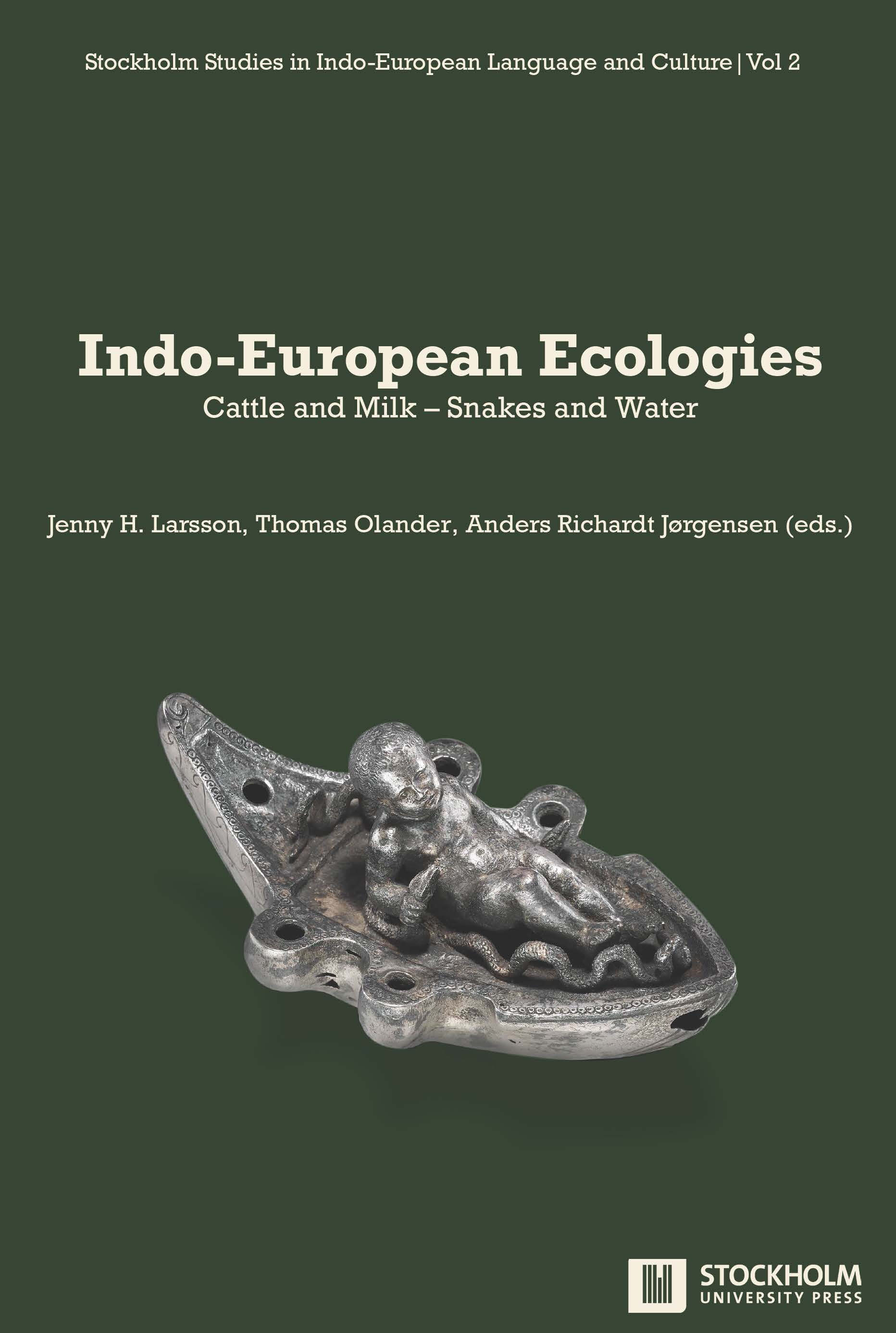
How did the early Indo-European communities understand and mythologise their natural and social environments? The edited volume Indo-European Ecologies: Cattle and Milk – Snakes and Water introduces ecological perspectives into the study of Indo-European traditions.
The main focus is on the early Indo-European beliefs surrounding the most important elements of the household, above all cattle and milk, as well as a number of threats to the household, such as serpents, lizards and dangerous strangers.
From sacred cattle and milk rituals to the chthonic symbolism of serpents and the mythological periphery of water, this interdisciplinary volume offers a better historical understanding of human–animal relationships and the relationship between human and nature. It uncovers deep-rooted ecological imaginaries embedded in language, archaeology, and comparative mythology. With contributions spanning from the Indo-Iranian plains to the Baltic forests, the book reveals how beliefs about animals, agriculture and the household shaped Indo-European worldviews.
Rich in detail and accessible in style, the book is aimed at scholars and curious readers alike.
The editors of the book
Jenny Helena Larsson is Professor of Baltic Languages and Director of the Centre for Indo-European Language and Culture at Stockholm University. She is co-PI of the National Centre of Excellence Centre
for the Human Past and PI of the research programme Languages and Myths in Prehistory (LAMP).
Anders Richardt Jørgensen obtained his PhD in Indo-European linguistics from the University of Copenhagen. His research focuses on comparative Indo-European and Celtic linguistics, Middle Breton
philology and Modern Breton dialectology. He is currently a researcher at Uppsala University in the research programme Languages and Myths in Prehistory (LAMP).
Thomas Olander is Professor of Indo-European Studies at the Roots of Europe centre at the University of Copenhagen. His research interests include linguistic reconstruction and the relationship between recon-
structed languages and the archaeological record. He is PI of the research project The Indo-European Dark Ages Illuminated and a member of the research programme Languages and Myths in Prehistory (LAMP)
Stockholm Studies in Indo-European Language and Culture
Stockholm Studies in Indo-European Language and Culture (SIELC) (ISSN 2004-9080) is a peer-reviewed series of monographs and edited volumes published by Stockholm University Press. SIELC is a cross-disciplinary series intended for research into the older stages of the Indo-European language family from a multitude of perspectives, including history of religions, archaeology, ancient DNA and historical linguistics.
How to access this book
At the Stockholm University Press website you can download an ePub or pdf-file that allows you to read the book online or access it on multiple devices. You may also order a print copy of the book through the website. DOI: https://doi.org/10.16993/bcu
About the publisher Stockholm University Press
Stockholm University Press (SUP) is an open access publisher of peer-reviewed academic journals and books. We aim to make journals and books affordable, and to give them the widest possible dissemination, so that researchers around the world can find and access the information they need without barriers.
 Stockholm University Press Blog