
Sweden and South Korea both have strong ambitions to provide social welfare, but the history and legal traditions of the two countries are very different. The Swedish “Folkhemmet” started being built almost a hundred years ago whereas South Korea’s welfare state emerged properly only after democratization in the 1980s and following a strong economic development in the new millennium. The similarity in ambitions in combination with how differently they are pursued surprised the editors of this comparative study.
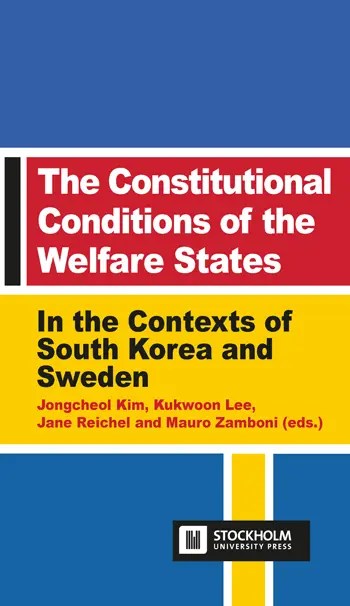
The first book released in the new Stockholm Law Series – The Constitutional Conditions of the Welfare States – In the Contexts of South Korea and Sweden – is the culmination of a research project, funded by STINT (The Swedish Foundation for International Cooperation in Research and Higher Education) and The National Research Foundation of Korea, in which twelve researchers from the two countries focused on different aspects of constitutional law, welfare and social rights in Sweden and South Korea respectively.
“What role does the constitution play in shaping welfare politics in South Korea and Sweden? Does it act as a proactive catalyst, driving legal discourse and advancements, or does it merely serve as a reflective surface, passively mirroring the political realities shaped by external forces?” – Jongcheol Kim, Kukwoon Lee et al. in the introduction of the book
The project began with a longstanding collaboration between Jongcheol Kim (The School of Law at Yonsei University in Seoul) Kukwoon Lee (The School of Law at Handong Global University) in South Korea and Mauro Zamboni (The Faculty of Law at Stockholm University. Together with Jane Reichel, also at The Faculty of Law at Stockholm University, they make up the editorial team for this volume.
Bringing together different perspectives has had its practical implications for the project that started before the Covid pandemic.
“Sustaining an international collaboration through the pandemic and the changing circumstances in which academic colleagues work has been challenging. The project began with a workshop in Stockholm in 2019, continued through online discussions, and eventually brought us together again in person.”
But the efforts have contributed greatly to the relevance of the book.
“The different perspectives were one of the book’s strengths,” continues Jane Reichel. “They helped us see how a broad question about constitutions and welfare plays out in specific fields of law.”
By comparing Sweden’s long-established welfare model with South Korea’s more recent welfare development, the book highlights how different constitutional traditions influence the protection and realization of welfare rights.
“The comparison was especially appealing because the two countries present an intriguing puzzle: they pursue recognisable welfare goals, yet the relationship between constitutional law, legislation and other social institutions differs considerably” – Mauro Zamboni.
One of the positive effects of publishing your research with open access is that it becomes instantly available around the world, allowing research to build on previous research. Perhaps this book can inspire new comparisons. The editors themselves are also very much interested in continued research.
“One question we would like to pursue further is when a constitution actively shapes welfare policy and when it mainly reflects choices made through politics and legislation. Comparing Sweden and South Korea also made us curious about other countries: would we find similar relationships between constitutional commitments and everyday welfare provision, or different ones again? The book opens that inquiry rather than claiming to settle it.”, says Mauro Zamboni.
“Regardless of whether the focus is on Sweden or South Korea, constitutional scholars in both countries engage within a shared theoretical and conceptual framework. While local factors undoubtedly shape the processes and outcomes regarding the positioning of welfare rights within constitutional discourse, these processes occur in contexts that are widely recognizable to the participants in such discourse.” – Jongcheol Kim, Kukwoon Lee et al. in the book’s concluding chapter.
Making the constitutional comparison also brought perspective and new ways of looking at the situation in your country.
“Looking at Sweden through Korean experiences made features of Swedish legal culture easier to see. Arrangements that can appear natural or inevitable from within one country turn out to be the result of a particular history, including choices about legislation, public institutions and the role of organised social actors. The comparison was a reminder that changing the law is only one part of changing how a society works”, says Jane Reichel.
“We hope the book encourages readers to look at their own system with fresh eyes.” – Jane Reichel.
Publications Issued by the Faculty of Law
The Constitutional Conditions of the Welfare States – In the Contexts of South Korea and Sweden is the first publication in Stockholm Law Series, a book series for academic, peer reviewed monographs and edited volumes in legal science, published by Stockholm University Press in collaboration with The Foundation Publications Issued by the Faculty of Law at Stockholm University.
Download the book for free! https://doi.org/10.16993/bda

