
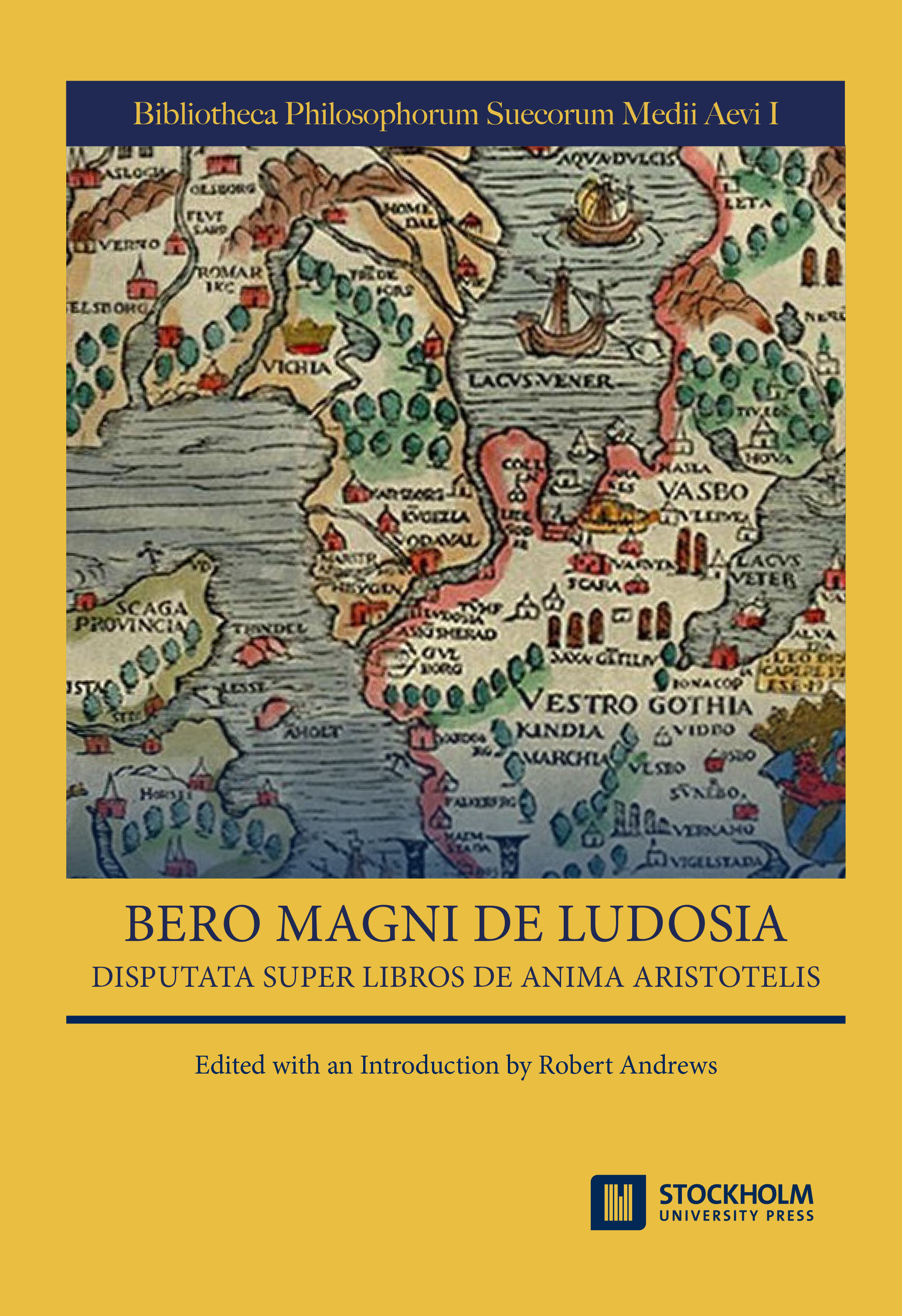
“Bero Magni de Ludosia: Disputata super libros De anima Aristotelis” is the first book in our new book series on medieval philosophy, Bibliotheca Philosophorum Suecorum Medii Aevi. It is a critical edition of a 15th Century manuscript in Latin by Bero Magni, a Swedish native who became Master of Philosophy at the University of Vienna, commented and introduced by Robert Andrews.
Bero Magni de Ludosia
Bero Magni (Björn Magnusson) was born in the Swedish coastal city of Ludosia (Lödöse) around 1409. After studies at the cathedral school in Skara, he pursued an academic career at the University of Vienna. He was elected bishop to the diocese of Skara but stayed in Vienna and never returned to become bishop. He did however leave a substantial number of books from his library to the diocese at his death.
Disputata super libros De anima Aristotelis
The Disputata super libros De anima, surviving in a single manuscript dating from around 1433, and preserved in the Cistertian monastery in Heiligenkreuz, Austria, is described by Bero Magni as a disputatio, i.e. exercises held by a master in private rooms in order to elaborate upon lectures held previously. The genre of the work, a commentary on Aristotle’s De anima, was the primary vehicle in the medieval period for the investigation of psychology.
Throughout Bero’s work, the positions of John Buridan are defended. Indeed, it may be described as a super-commentary – that is, a commentary on John Buridan’s commentary on Aristotle’s De anima. As such it belongs within a tradition extending from Buridan to the Renaissance.
The extensive footnotes of this edition attempt to identify not only Bero’s sources, but also an entire spectrum of commentary, including Buridan (with different versions of his De anima commentary), Nicholas Oresme, Lawrence of Lindores, several anonymous commentaries, Benedictus Hesse (dating from around 1423-31), Ioannes de Lutrea in an edition from 1482, and Arnoldus de Usingen in an edition from 1507. In this progression Bero was on the right path of intellectual history, anticipating both the Reformation and the Scientific Revolution; Usingen, for example, was the professor of Luther, and the Buridanian John of Gogów influenced Copernicus.
Bibliotheca Philosophorum Suecorum Medii Aevi
Bibliotheca Philosophorum Suecorum Medii Aevi publishes books on Swedish medieval philosophy. The main publication will consist of new critical editions of texts of Swedish medieval philosophers, but the book series also publishes other literature in the form of anthologies and monographs as well as translations.
The series takes a broad perspective on philosophy in the Middle Ages, which can include philosophical theology but also religious mysticism with philosophical elements. Normally, however, it refers to the philosophy practiced at the universities during the Middle Ages. For the purpose of this series, the “Middle Ages” refers to the time period between 1000 and 1600.
How to access this book
At the Stockholm University Press website you can download an ePub or pdf-file that allows you to read the book online or access it on multiple devices. You may also also order a print copy of the book through the DOI-link: https://doi.org/10.16993/bdb
About the publisher Stockholm University Press
Stockholm University Press is an open access publisher of peer-reviewed academic journals and books. We aim to make journals and books affordable, and to give them the widest possible dissemination, so that researchers around the world can find and access the information they need without barriers.

